What Happens Inside a Kiln at 1200°C — The Science Behind Stoneware
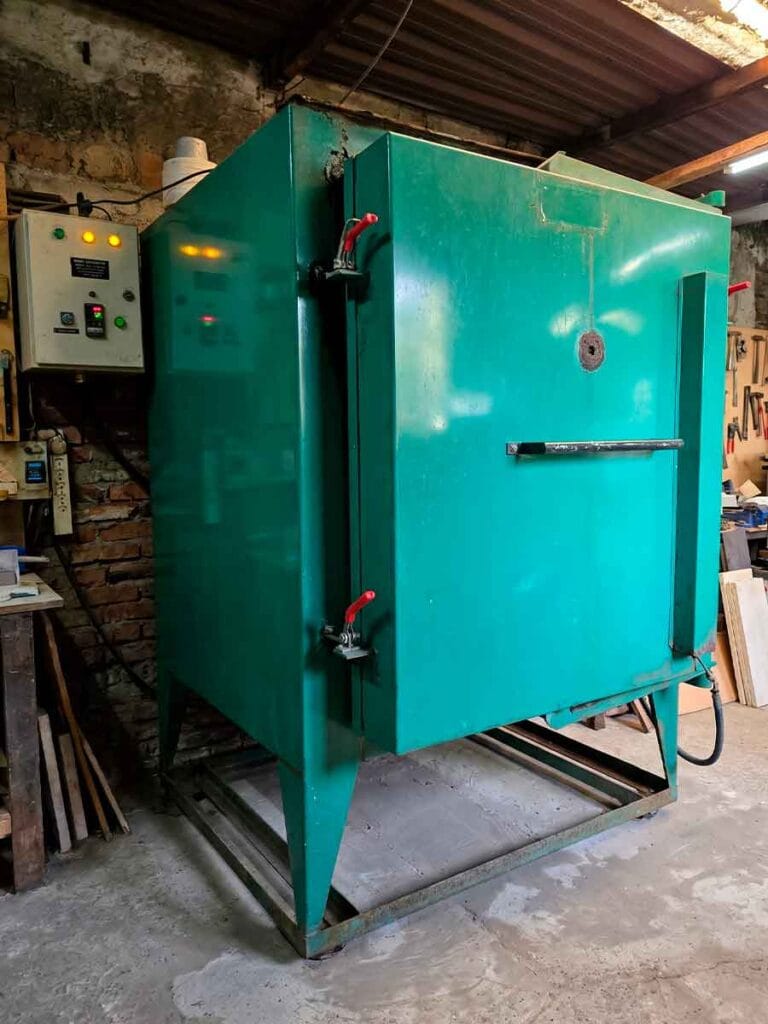
The stoneware firing temperature in my kiln is 1200°C. That number appears on every product page of this site, in every description of every piece I make. It is not decoration. It is the most important fact about how these objects exist.
This is what happens inside the kiln when that temperature is reached — and why it cannot be rushed, approximated, or replaced by anything cooler.
The Kiln — One Cubic Meter of Refractory Brick
My kiln is one cubic meter of refractory brick. It is the most precious object in my studio — not because of what it cost, but because of what it decides. I have been firing in this kiln for decades. It knows things about clay that I have had to learn to understand.
A refractory kiln is built to hold heat without degrading. The bricks that line it are made from materials that withstand extreme temperatures — alumina, silica, fireclay — and they store heat the way stone stores warmth from the sun. When the kiln reaches temperature, it is not just hot. It is saturated with heat, in every direction, evenly. That evenness is what a good firing requires.
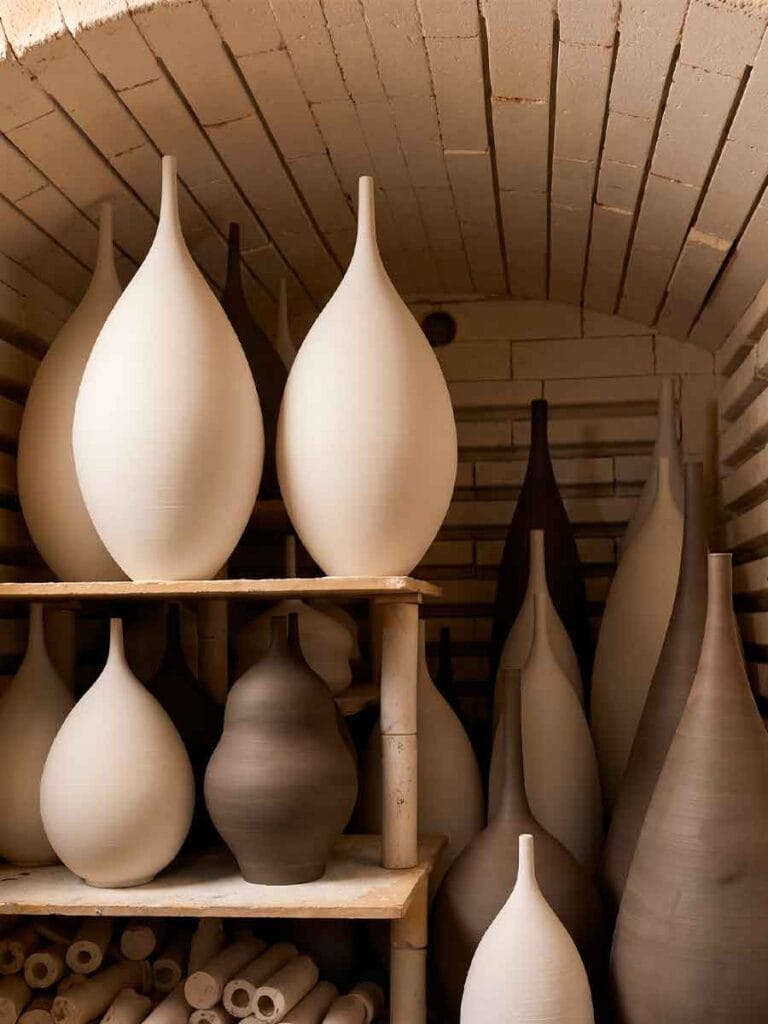
When I load the kiln and close the door, I raise the temperature slowly — over hours, not minutes. I cannot rush the process. The clay cannot either.
The Stages of a Stoneware Firing Temperature
A firing at 1200°C does not begin at 1200°C. It begins at room temperature and climbs slowly through a series of transformations, each one irreversible.
Between 100°C and 200°C, the remaining moisture in the clay evaporates. If a piece is not completely dry before the firing begins, the steam produced at this stage can crack or explode the clay from the inside. Patience here is not optional.
Between 300°C and 600°C, the clay undergoes what ceramicists call quartz inversion — a structural rearrangement of the silica crystals in the clay body. The kiln must pass through this range slowly, in both directions: heating and cooling. Too fast, and pieces crack.
At around 600°C, the chemically bound water in the clay burns off permanently. The clay is now no longer reversible — it cannot be rewetted and reworked. It has crossed a threshold it cannot return from.
Between 900°C and 1100°C, sintering begins. The clay particles start to bond to each other. The piece starts to become dense. It begins to shrink — stoneware typically shrinks between 10% and 15% during firing, which is why every dimension I throw on the wheel accounts for what the fire will take.
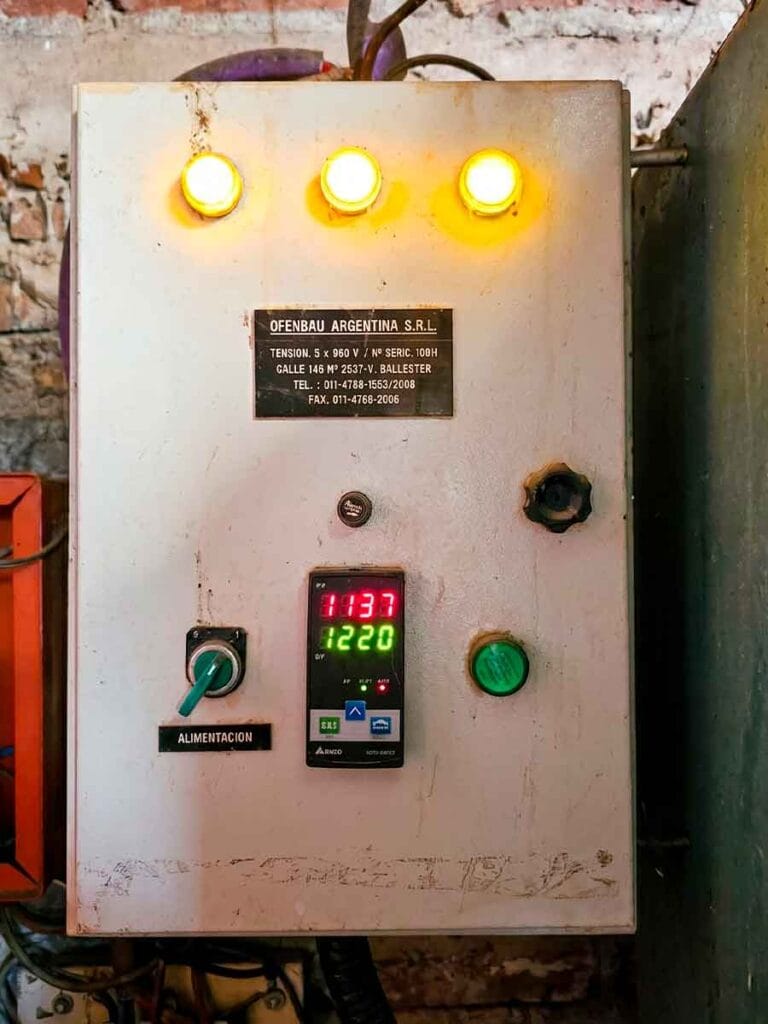
At 1200°C, the feldspar in the clay and in the mineral slip begins to flux — to partially melt and flow into the spaces between clay particles. This is vitrification. The clay body becomes dense, non-porous, and structurally permanent. The slip fuses with the body beneath it. The object becomes what it will be for the rest of its existence.
What the Stoneware Firing Temperature Does to Clay
Vitrification is the transformation that separates high-fire stoneware from everything fired below it. Below 1100°C, clay remains porous — it holds its shape, but it breathes, absorbs moisture, and remains structurally fragile relative to what it could be. At 1200°C, the silica and feldspar in the clay begin to melt and fill those pores. The result is a material that is dense, sealed, and permanent in a way that lower-fired ceramics cannot achieve.
A vitrified stoneware piece does not absorb water the way earthenware does. It does not stain as easily. Its surface, once fired, is sealed — the mineral slip fused to the body beneath it cannot be separated from it by any normal mechanical or chemical means. What you hold in your hand is not clay anymore. It is a new material, produced by the combination of clay, minerals, and extreme heat.
This is why the stoneware firing temperature matters. Not as a technical specification — as a fact about the object. Every piece that leaves my studio at Durao Studio was subjected to that heat. Everything it is now, it became there.
The Cooling — As Important as the Firing
What most people don’t consider is that the cooling is as critical as the firing. After reaching 1200°C, the kiln must cool slowly — over many hours, sometimes overnight — before it can be opened. The quartz inversion that occurs during heating happens again during cooling, and if the temperature drops too fast through that range, pieces crack.
I do not open my kiln until it has cooled to below 100°C. That requires patience of a different kind — the firing is done, the work is finished, and I cannot see it yet. I have learned not to rush that moment. The pieces that have survived the heat deserve to cool at their own pace.
When I finally open the door, what I find is what the fire decided. Some pieces are exactly what I imagined. Others are better. Occasionally, one is lost — cracked, warped, or changed in a way that disqualifies it. The fire is the final editor. I have learned to accept its decisions.
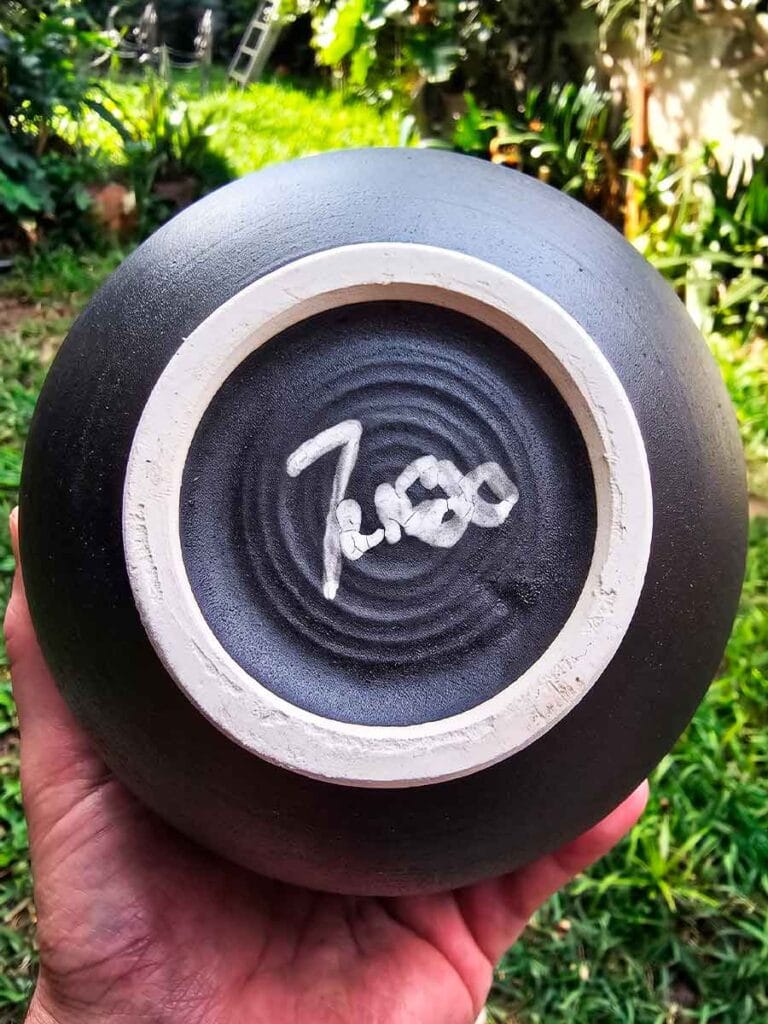
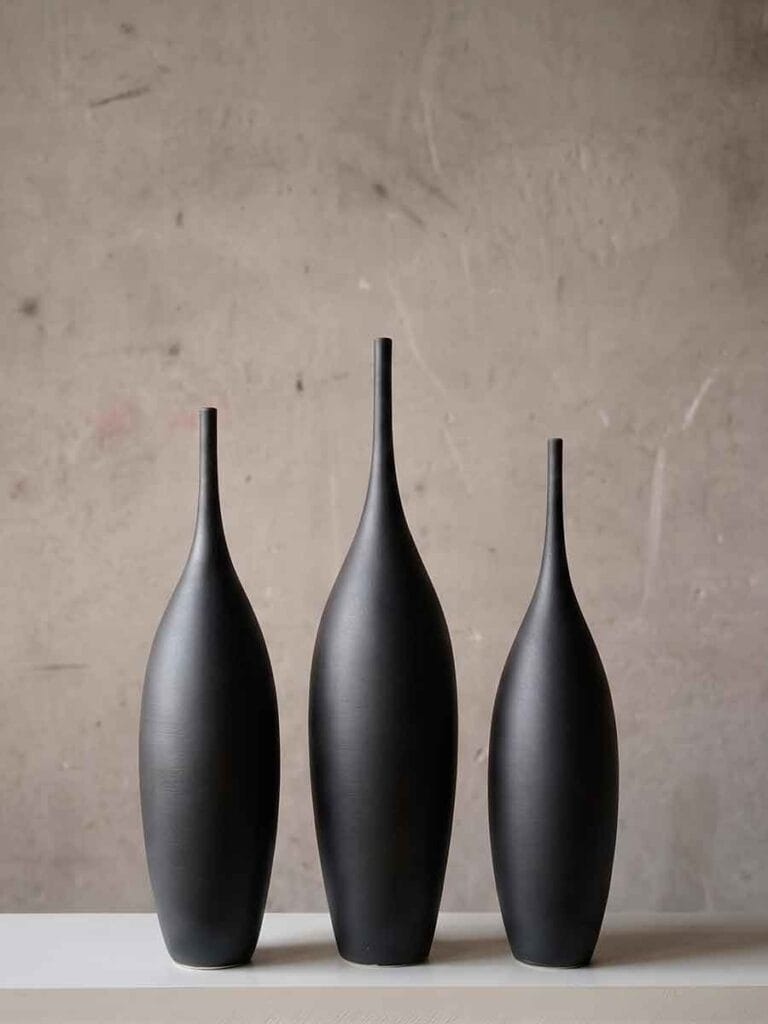
The stoneware firing temperature of 1200°C is not a number I chose for its impressiveness. It is the temperature at which the clay and the mineral slip become what they need to be — permanent, dense, and finished. Every piece in the Unikas Black, Unikas Quartz, and Moradores collections passed through that heat before it left my studio.
You can read more about the material in What Is High-Fire Stoneware, about the surface finish in Mineral Slip Ceramics — No Commercial Glazes, or about the process that shapes each piece in Wheel-Thrown Pottery: What It Is and Why It Still Matters.
To inquire about a specific piece, contact Fernando directly.
For a technical overview of kiln firing and ceramic chemistry, see the Ceramic firing entry on Wikipedia.