What Is High-Fire Stoneware — And Why It Makes Better Art

High-fire stoneware is the material behind every piece at Durao Studio. Not because it’s the most common choice — it isn’t — but because it’s the most demanding one, and that demand produces something that lower-temperature ceramics simply cannot: permanence.
This is a short explanation of what high-fire stoneware actually is, what happens to clay when it reaches 1200°C, and why that matters when you’re choosing a ceramic art object for your home.
What “High-Fire” Actually Means
Ceramics are classified by the temperature at which they’re fired. Low-fire ceramics are typically fired between 900°C and 1050°C — this includes earthenware and most terracotta. Mid-fire sits between 1050°C and 1180°C. High-fire starts at 1180°C and goes up to 1300°C or beyond.
Stoneware fired at 1200°C is at the lower end of the high-fire range — and still dramatically different from anything fired below it. At that temperature, the clay body undergoes a transformation that lower temperatures cannot achieve: vitrification.
What Vitrification Means for Ceramic Art
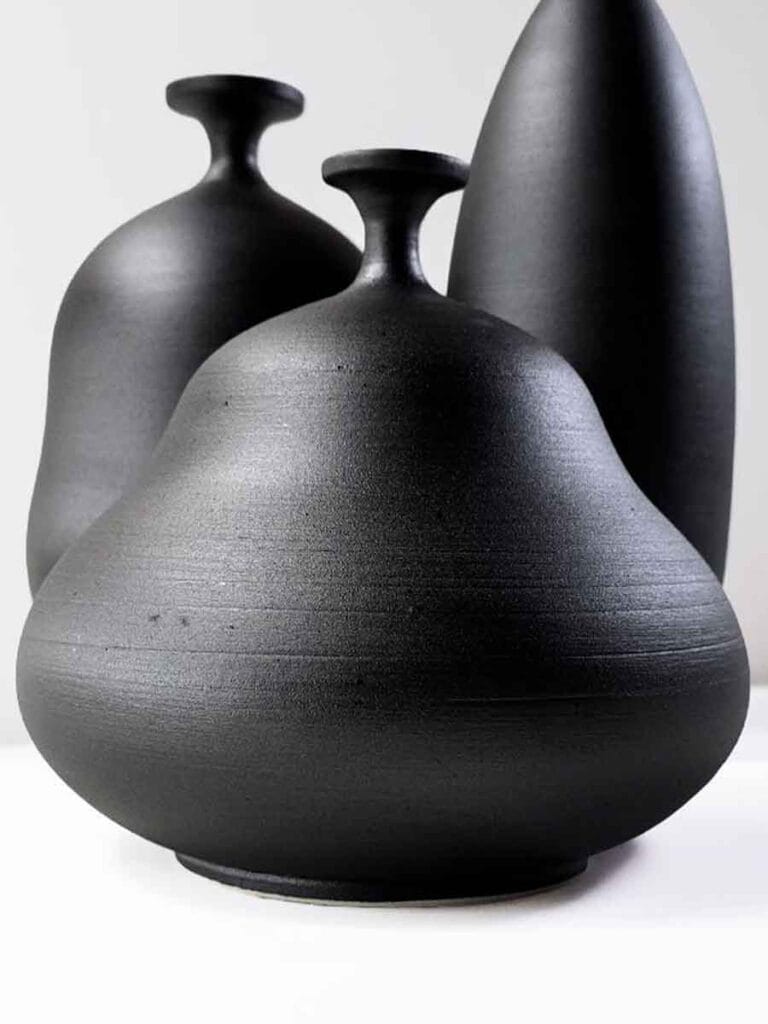
Vitrification is what happens when clay particles fuse together under extreme heat. Below 1100°C, clay remains porous — it holds its shape, but it breathes, absorbs moisture, and remains structurally fragile relative to what it could be. Above 1180°C, the silica in the clay begins to melt and fill the spaces between particles. The result is a material that is dense, non-porous, and structurally permanent in a way that lower-fired ceramics are not.
For a decorative ceramic art object, this matters in ways that aren’t always obvious. A vitrified stoneware vase doesn’t absorb dust the same way. It doesn’t stain as easily. Its surface, once fired, is sealed — what you see is what it will remain, without ongoing degradation. The object you receive is the object it will be for the rest of its existence.
High-Fire Stoneware vs Porcelain vs Earthenware
The three main ceramic materials — earthenware, stoneware, and porcelain — are often confused. The difference is primarily in clay composition and firing temperature.
Earthenware is fired at low temperatures. It remains porous, is typically heavier for its size, and is more fragile. Most terracotta is earthenware. It’s the most forgiving to work with and the least permanent.
Porcelain is made from a refined white clay (kaolin) and is fired at very high temperatures — often higher than stoneware. The result is a translucent, very white, very smooth material. Beautiful, but less forgiving on the wheel and less suited to the kind of surface work that Fernando does with mineral slips.
Stoneware sits between them — fired high enough to vitrify, but made from clay that is coarser, denser, and more receptive to surface treatment. It’s the material of choice for studio potters who work with texture, slip, and form as primary concerns. It has the structural integrity of porcelain without its clinical whiteness and its resistance to expressive surface work.
High-fire stoneware is also why Fernando’s pieces feel substantial in the hand. There is no lightness that reads as fragility. The weight is part of the object.
Why It Matters for Decorative Ceramic Art
When you buy a decorative ceramic object — a vase, a sculpture, a vessel — the firing temperature is rarely mentioned. Most commercial ceramics, including many sold as “handmade” or “artisan,” are earthenware or mid-fire stoneware. They are made to be affordable and produced at volume. The firing temperature is kept low to reduce energy costs and production time.
High-fire stoneware costs more to produce in every sense — more energy, more time, more risk. A firing at 1200°C takes hours to reach temperature, hours to cool, and demands precise control throughout. Pieces can crack, warp, or fail in ways that lower-temperature firings don’t produce. The rate of loss is higher. The commitment per piece is greater.
What the buyer receives, in exchange, is an object that was made under conditions that demanded the most from the material. That isn’t marketing. It’s physics.
High-Fire Stoneware at Durao Studio
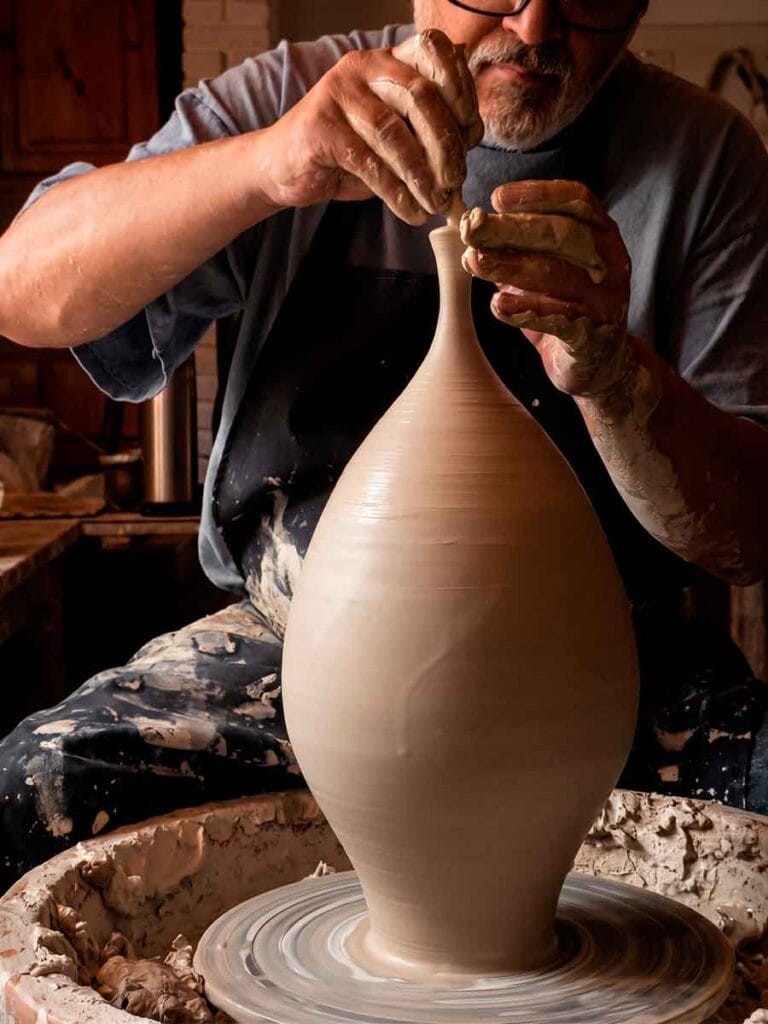
Every piece Fernando makes — across the Unikas Black, Unikas Quartz, and Moradores collections — is fired at 1200°C in high-fire stoneware. The clay bodies he works with are selected for their behavior at that temperature: how they move on the wheel, how they shrink during firing, how they receive the mineral slips he applies by hand.
Those slips — custom formulas built from iron oxides, feldspars, silica, and natural pigments — are also designed for high-fire conditions. At 1200°C, the slip fuses permanently with the clay body beneath it. The surface you see on a finished Unikas piece is not applied on top of the object. It is part of it.
Fernando has been working with high-fire stoneware for over 35 years. The material is not a choice he revisits — it is the foundation of everything he makes.
What This Means When You Buy
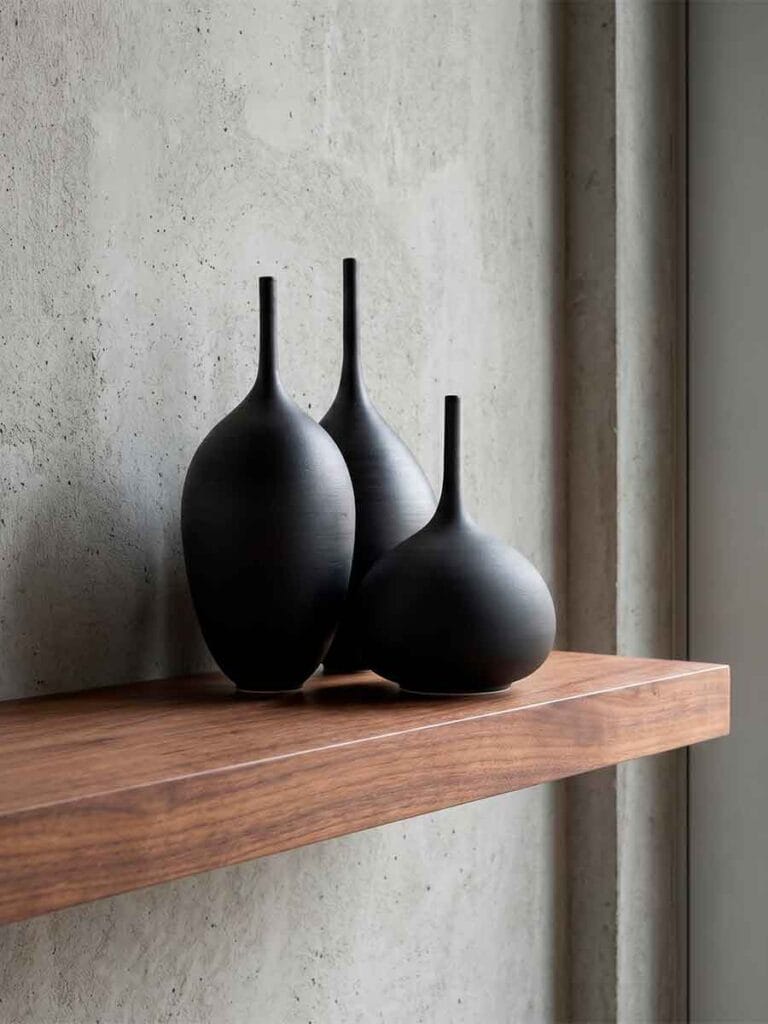
A high-fire stoneware ceramic art object is not fragile in the way that low-fire ceramics can be. It is not porous in the way that earthenware is. Its surface will not degrade over time with normal care. What it is, is dense — physically and visually. It occupies space with a weight that lower-temperature ceramics don’t carry.
If you’re choosing a ceramic piece for a space that matters to you, the firing temperature is worth knowing. It tells you something about how the piece was made, what it cost to produce, and how long it will remain what it is when you bring it home.
Each piece at Durao Studio is made from high-fire stoneware, thrown on the wheel, and finished with custom mineral slips developed in Fernando’s Buenos Aires studio. Browse the Unikas Black and Unikas Quartz collections, or read about Fernando’s 35 years at the wheel.
For questions about the work or to inquire about a specific piece, contact Fernando directly.
For a technical overview of stoneware firing, see the Stoneware entry on Wikipedia.