Black Ceramic Vases: What to Look for When You Buy
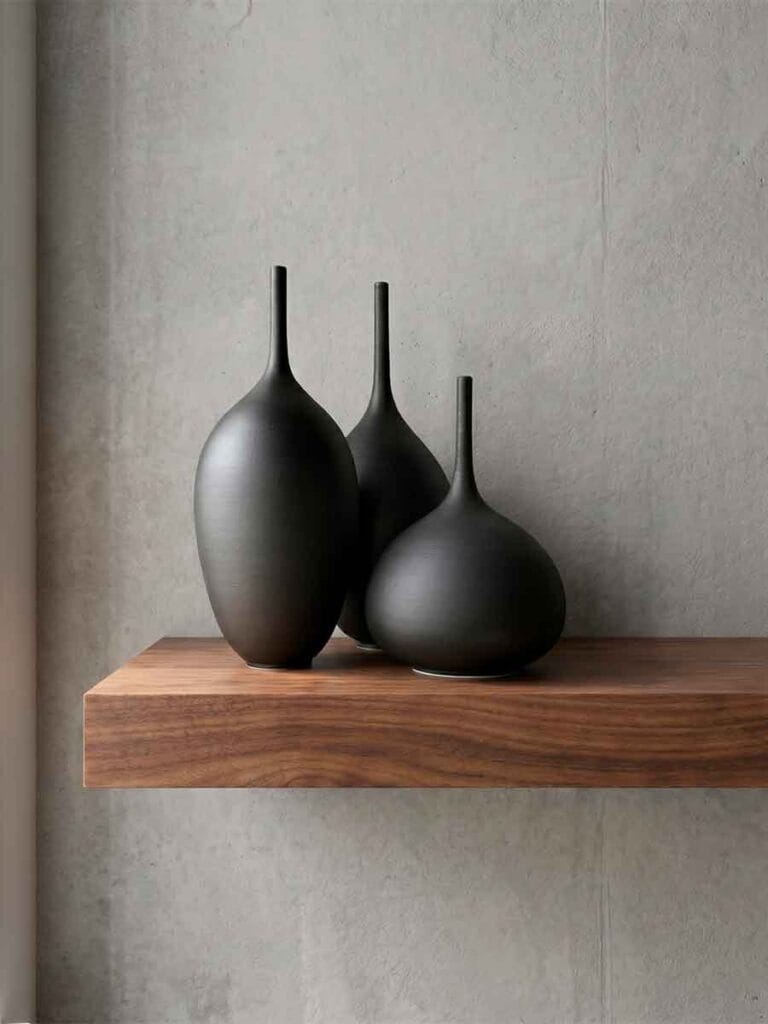
A black ceramic vase is one of the most searched decorative objects in the US interior design market right now. That demand has produced an enormous range of options — from $18 mass-produced pieces to $900 handmade stoneware from independent studios. The difference between them is not only price. It is material, process, and permanence.
This is what to look for when you buy a black ceramic vase — and why those distinctions matter more than they might appear to.
Why Black Ceramic Is Having a Moment in Interior Design
The appeal of black in interior design is not complicated. Black absorbs light rather than reflecting it — it creates presence without noise. In a room with warm woods, raw concrete, or natural linen, a black ceramic vase reads as an anchor: something that holds the composition without competing with it.
What makes ceramic specifically interesting in that context is its materiality. A black ceramic surface is not the same as black paint or black metal. It has texture, density, and a surface that responds differently to different light conditions — absorbing direct light, revealing depth in shadow. That quality comes from the clay and the mineral finish beneath the surface, not from the color alone.
Black Ceramic Vase — Mineral Slip vs Commercial Glaze
The most important distinction when buying a black ceramic vase is the surface finish — and specifically, whether that finish is a commercial glaze or a mineral slip.
A commercial black glaze is a pre-formulated product applied to the surface of the clay and fired. It produces a consistent, uniform black surface — the same across every piece, across every studio that uses it. The color is reliable. The texture is controlled. The result is predictable, which is exactly what makes it appropriate for mass production and exactly what makes it uninteresting for a space that deserves better.
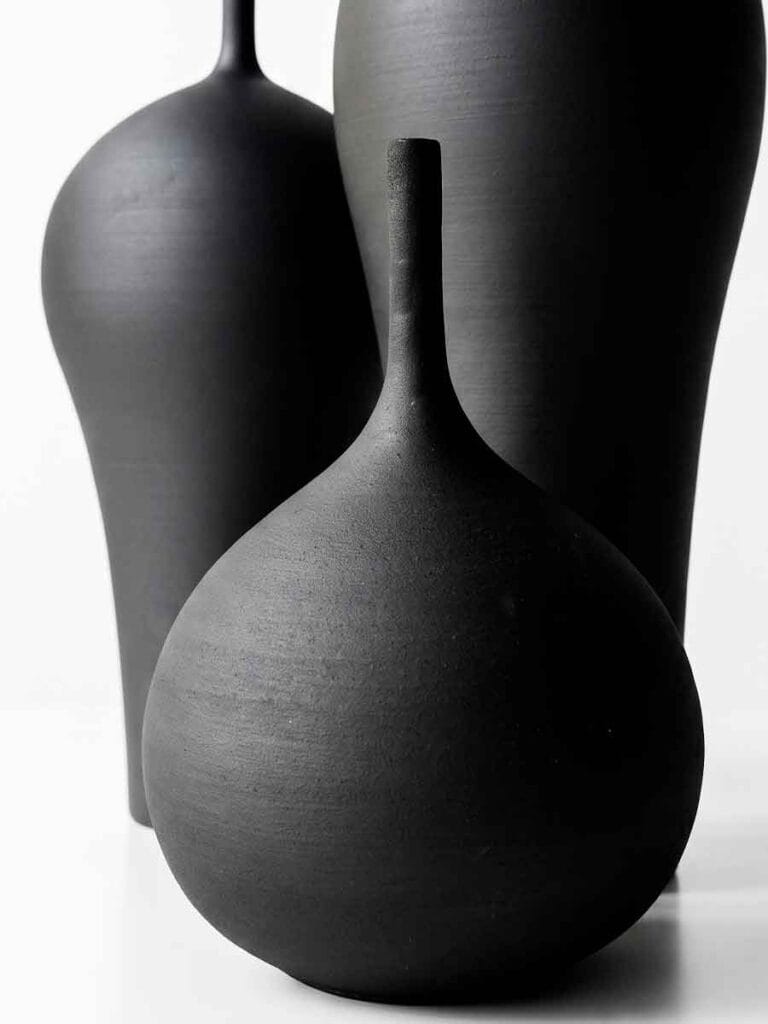
A mineral slip is different. It is a formula built from raw materials — in Fernando’s case, iron oxides, feldspars, silica, and other minerals — mixed to a specific consistency and applied by brush, layer by layer, directly onto the raw clay body. The black that emerges from the kiln is not the same in every light, not perfectly uniform, not reproducible by any other studio using any other formula. It is a surface with depth, with directionality, with evidence of its own making. Under your fingers, it feels like compressed stone.
That difference is visible. Once you know what to look for, you can see it in photographs.
Matte or Satin — Why the Finish Varies
Not all black ceramic vases have the same finish — and in the Unikas Black collection, that variation is intentional.
The surface of each piece ranges from deep matte to satin, depending on the number of slip layers applied and the firing temperature reached in the kiln. A piece fired at the lower end of the high-fire range with fewer layers will read as fully matte — dense, flat, light-absorbing. A piece fired higher, with more layers of slip, develops a quiet satin depth that shifts with the angle of light: darker in shadow, with a subtle warmth where light catches it directly.
That variation is not a quality control issue. It is what happens when the surface is produced by a mineral formula rather than a commercial glaze. No two pieces have exactly the same finish, because no two pieces were fired under exactly the same conditions. The fire decides.

What You’re Actually Buying
A wheel-thrown black ceramic vase fired at 1200°C is a different category of object from anything produced in volume. Not better in the way that luxury goods are better — more expensive materials, more prestigious branding. Different in a more fundamental sense: it was made once, by one person, and it will not be made again.
The weight you feel when you hold it is the weight of vitrified stoneware — clay that has passed through 1200°C and become something denser than it was. The surface you touch is not a coating. It is the result of a mineral slip fused permanently into the clay body during firing. These are not qualities that can be approximated at volume. They are the direct consequence of a process that cannot be shortened.
What you’re buying is that process — and the specific, unrepeatable object it produced.
How to Style a Black Ceramic Vase
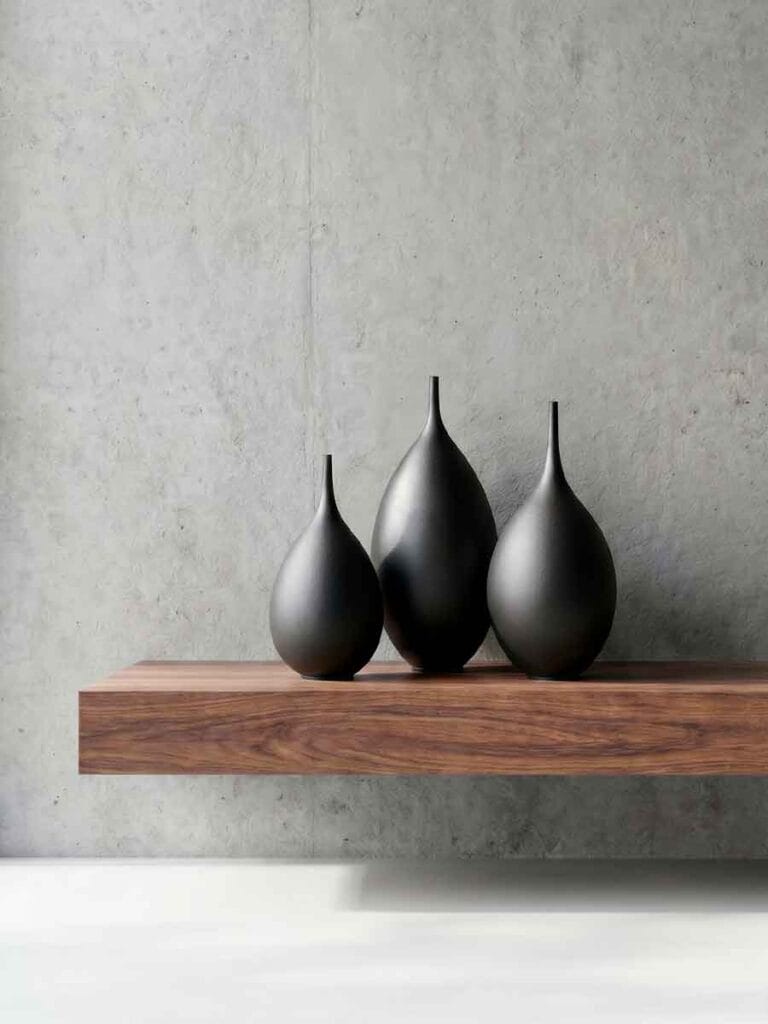
A black ceramic vase with genuine surface depth doesn’t need much around it. That is its value in a designed space — it resolves the composition rather than adding to it.
A few principles that work consistently:
On a shelf: A single black ceramic vase or a group of three in graduated sizes, against a light wall. The contrast does the work. Don’t add objects that compete — let the ceramic breathe.
On a console or sideboard: Pair with warm wood and something organic — a branch, a stone, a book. Black ceramic against warm wood is one of the most reliable combinations in contemporary interior design.
On a floor: Large format black stoneware vases work on the floor, in a corner, against raw concrete or plaster. This is where form matters most — the vase needs to have enough presence to hold the space on its own.
Without flowers: A black ceramic vase doesn’t need flowers. The form is the point. If you feel the need to fill it, the piece probably isn’t strong enough on its own.
For spaces that call for something beyond the vessel — a presence rather than a container — the Moradores sculptures work alongside the Unikas Black pieces with the same material logic: black stoneware, mineral slip, one of a kind.

Browse the full Unikas Black collection and the Moradores sculptures, or read about the process behind every piece in Mineral Slip Ceramics and What Is High-Fire Stoneware.
To inquire about a specific piece or discuss pricing, contact Fernando directly.
For context on current interior design trends, see Interior design on Wikipedia.