Abstract Ceramic Sculpture for the Home: How to Choose and Where to Place It

An abstract ceramic sculpture does something to a room that a vase cannot. A vase holds flowers, holds space, holds a corner. A sculpture holds attention. It doesn’t offer utility as justification for its presence — it offers itself, and asks the room to reorganize around it.
Choosing an abstract ceramic sculpture for your home is a different kind of decision from choosing a decorative object. This is how to make it well.
Abstract Ceramic Sculpture vs Decorative Object — What’s the Difference
The distinction between a sculpture and a decorative object is not always clear — and the market deliberately blurs it. A mass-produced figurine sold as “sculpture” and a one-of-a-kind ceramic work made by hand are both called sculptures. They are not the same thing.
A decorative object is made to fill a space pleasantly. It is designed to coordinate with other objects, to not demand too much attention, to be part of a composition rather than the starting point of one.
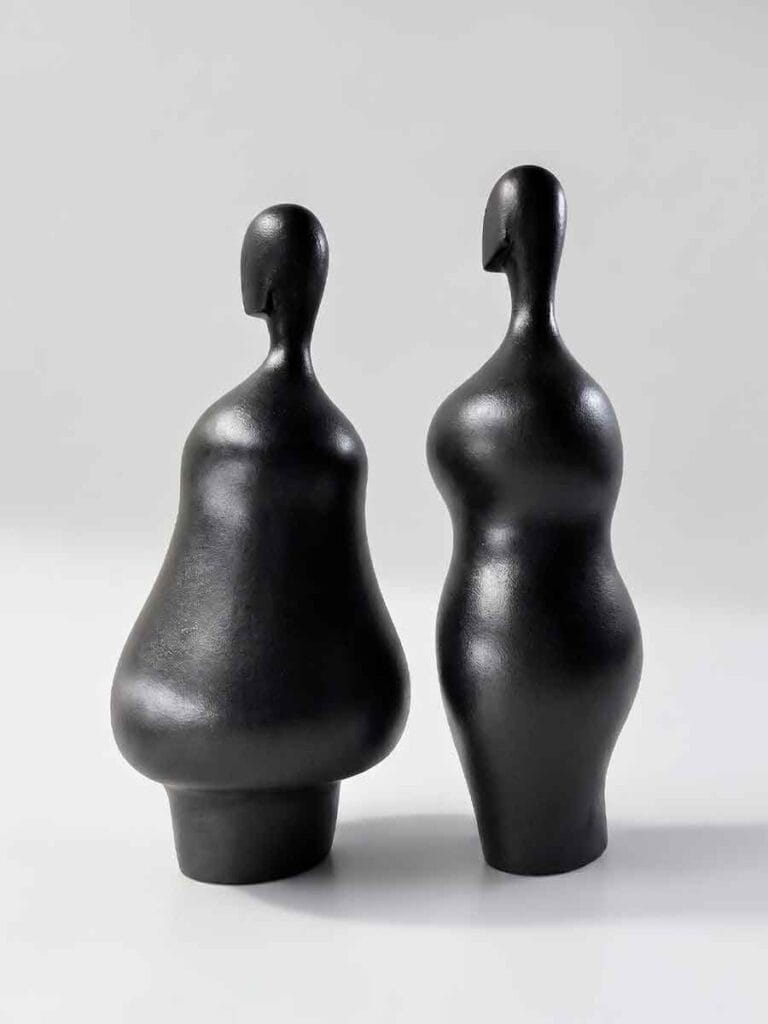
An abstract ceramic sculpture is made to be looked at. It has a formal logic — a relationship between volumes, between convex and concave surfaces, between mass and line — that rewards sustained attention. It changes as you move around it. It reads differently in morning light than in evening light. It is not background. It is the thing the room is organized around.
The test is simple: if the object could be replaced by any other object of similar size and color without changing anything essential, it is a decorative object. If its removal would leave a specific absence, it is a sculpture.
How Abstract Ceramic Sculpture Is Made — The Moradores Process
The Moradores series begins on the wheel — but it doesn’t end there.
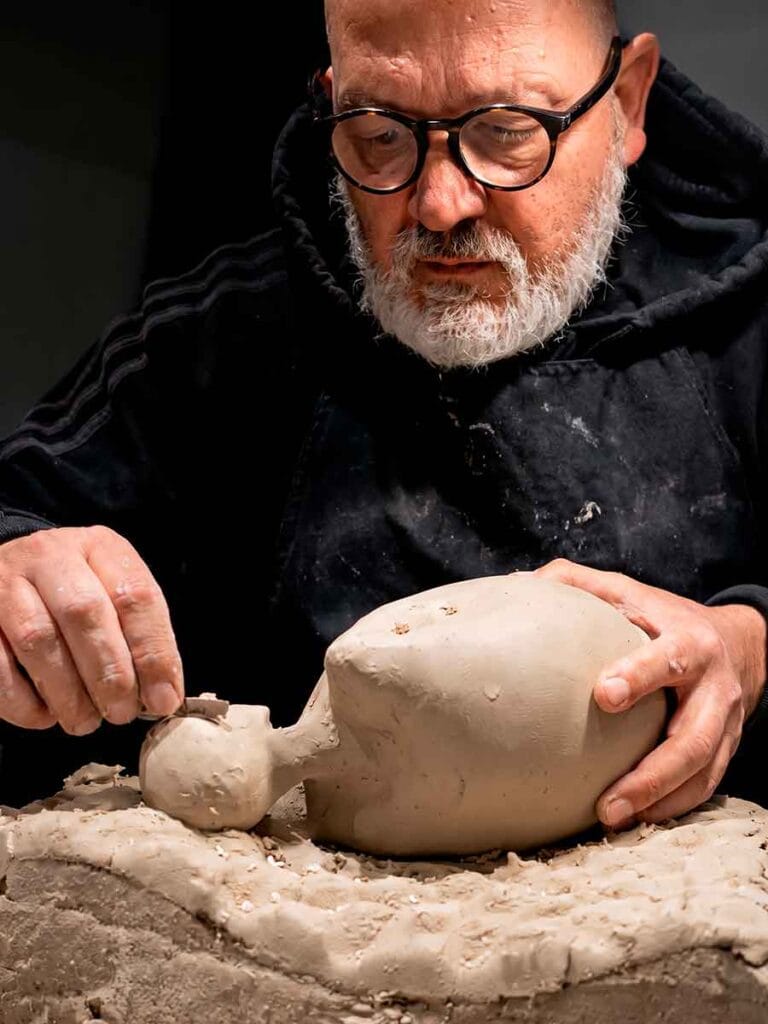
Fernando throws the initial form on the wheel: a closed, rounded volume that establishes the scale and the basic proportions of the piece. From that point, the wheel stops and the hands take over. Each sculpture is developed through a combination of pinching, paddling, and adding clay — a process of pushing from the inside, compressing from the outside, and reading the form as it develops to decide what it wants to become.
That last phrase is not metaphorical. After thirty-five years of working with clay, Fernando has learned to read a form in progress — to understand what a volume is trying to resolve into, and to help it get there without imposing a predetermined outcome. The Moradores are not designed before they are made. They emerge from the making.
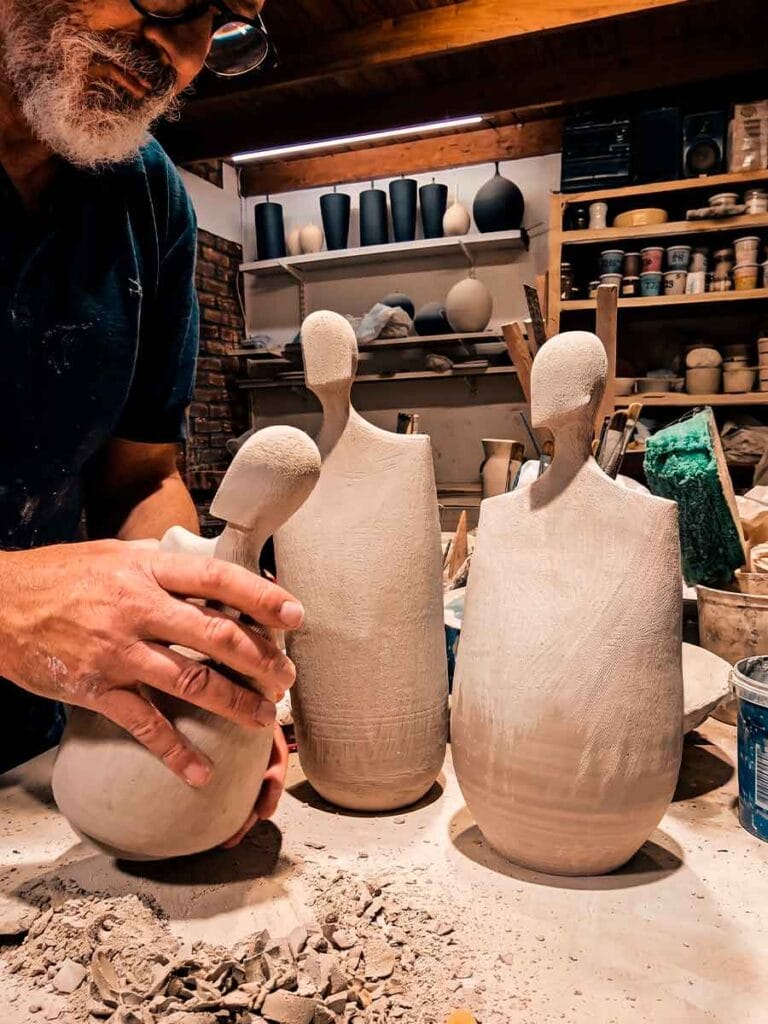
This process is what gives each sculpture its specific character — the way one figure leans, the particular tension in a shoulder, the relationship between the mass of the body and the scale of the head. These are not decisions made at a drawing board. They are decisions made in clay, in real time, that cannot be replicated.
Each Morador is one of a kind. Once fired, it is finished — and it will not be made again.
Scale, Placement, and Negative Space
Where you place an abstract ceramic sculpture matters as much as which sculpture you choose. A few principles that hold consistently:
Scale relative to the surface: A sculpture placed on a shelf should have enough vertical presence to be seen from across the room, but not so much that it overwhelms the shelf itself. The Moradores range in height — some are compact and dense, others tall and linear — and that variation is intentional. Different scales work in different contexts.
Negative space: A sculpture needs room around it. Crowding it with other objects reduces it to decoration. The space around a ceramic sculpture is part of the composition — it is what allows the form to read clearly and fully.
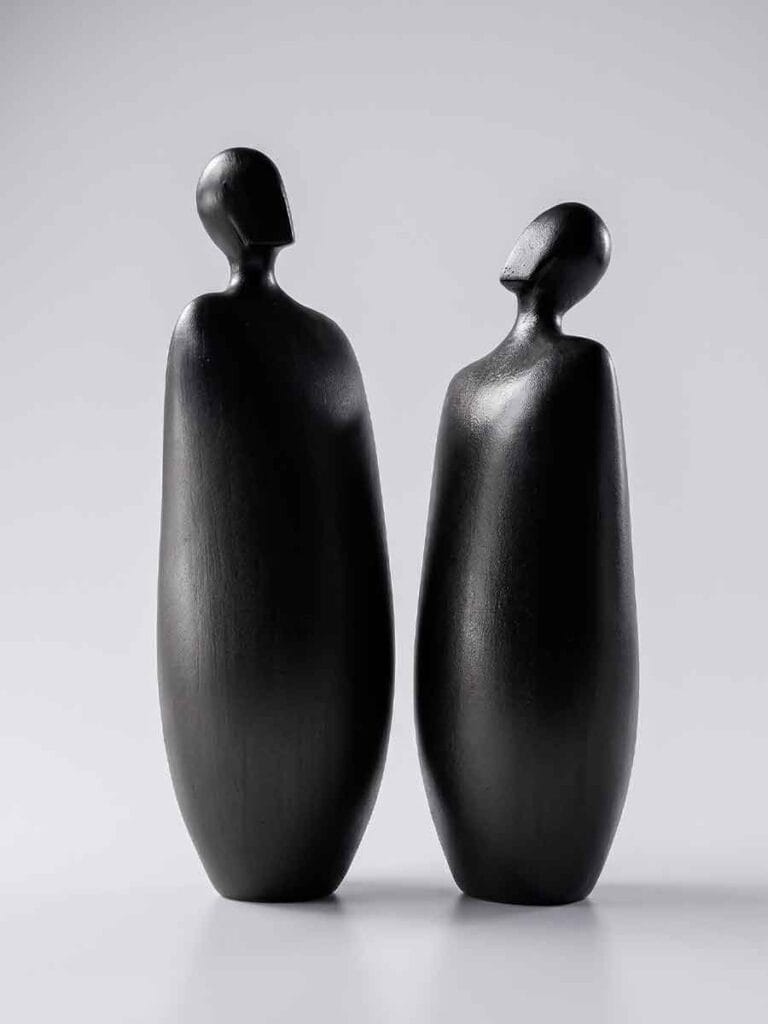
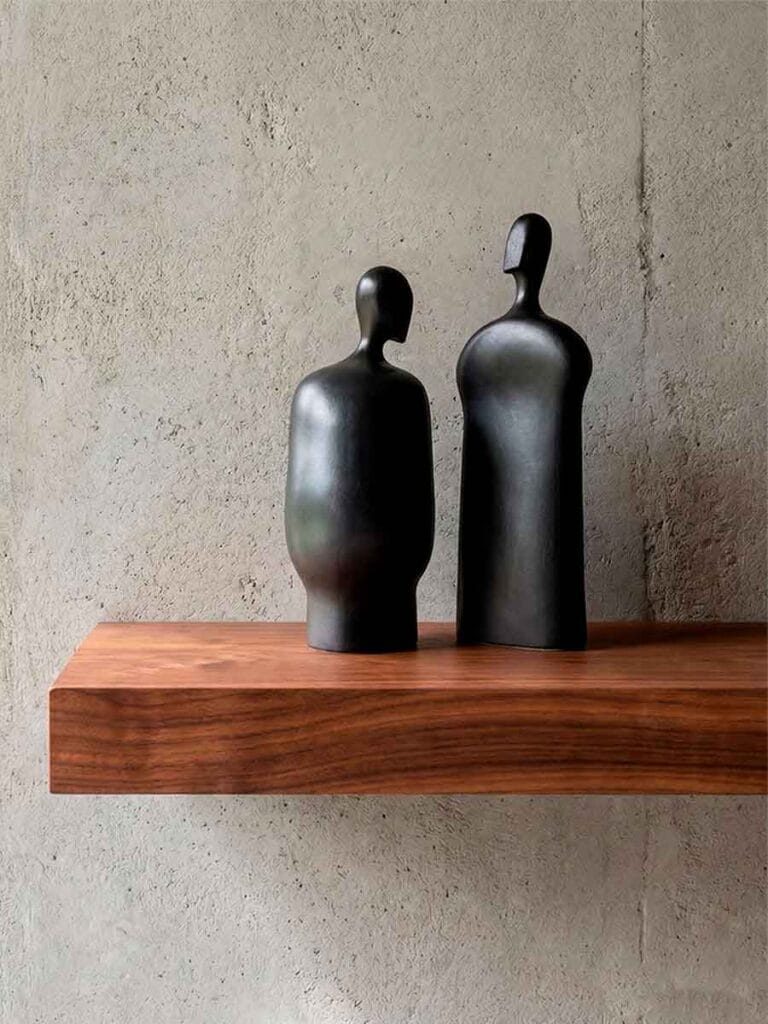
Singular or paired: The Moradores are currently offered in pairs, but they also work individually. A single sculpture on a shelf or console, with sufficient space around it, can hold an entire wall. Two sculptures in dialogue — leaning toward each other, or turned away — create a narrative that a single object cannot.
Height: Sculptures at eye level when seated read differently from sculptures at standing height. At eye level, the relationship is intimate — you are in the space with the object. At standing height, the relationship is more formal, more architectural.
Abstract Ceramic Sculpture and the Moradores — Inhabiting a Room
The name Moradores comes from the Spanish word for inhabitants. It is not an accidental choice.
These sculptures are not made to decorate a room. They are made to live in it. Each piece has a posture, a weight, a presence that reads as inhabited — not human in any literal sense, but in the sense that a room with a Morador in it feels occupied in a way it did not before.
That quality is the result of the process: forms that were not designed but emerged, surfaces that carry the evidence of their making, figures that suggest a body without representing one. The abstraction is deliberate — specific enough to read as a presence, open enough to resist a single interpretation.
Each Morador is finished in a black stoneware slip — the same mineral iron oxide formula used in the Unikas Black collection, fired at 1200°C. The surface ranges from matte to satin depending on the layers applied and the temperature reached in that specific firing. Like everything at Durao Studio, it is one of a kind. Once it leaves the studio, that specific figure will not exist again.
Browse the full Moradores collection — abstract ceramic sculptures made in Buenos Aires, shipped to the United States with a signed certificate of authenticity.
For the vessel collections made from the same stoneware body, see Unikas Black and Unikas Quartz. For context on what makes each piece truly unrepeatable, read One of a Kind Ceramic Art: What It Really Means.
To inquire about a specific piece or discuss availability, contact Fernando directly.
Follow the studio on Instagram: @durao.studio
For context on abstract sculpture as an art form, see Abstract sculpture on Wikipedia.